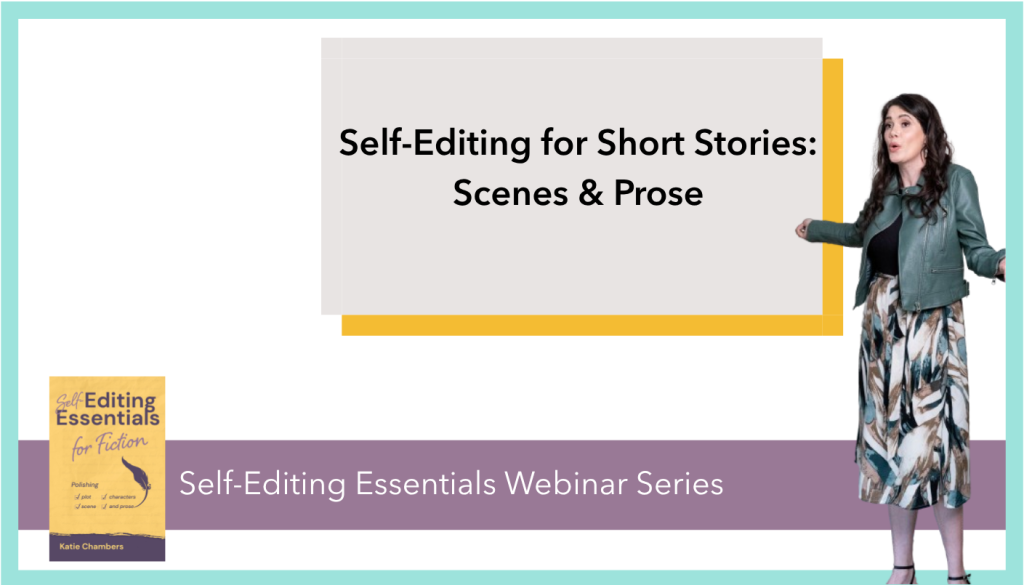
Make your short story tighter, stronger, and more compelling—without trying to fix everything at once.
**Note: While this presentation was for short-story authors, these principles apply to novels as well.**
You’ve written the story. Now comes the part that can make it shine: self-editing.
But if you’ve ever opened your draft and thought, Where do I even start? you’re not alone. Most writers know their story needs another pass, but trying to revise the plot, characters, scenes, sentences, dialogue, emotions, grammar, and punctuation all at the same time is a fast track to overwhelm.
That’s why intentional self-editing needs a system.
In this webinar, I walk you through a system then teach the four most practical, high-impact self-editing techniques for short stories. Whether you’re submitting to an anthology, revising a short story for a contest, or strengthening a piece before sharing it with critique partners or beta readers, this webinar will help you see your draft with clearer, more editorial eyes.
What you’ll learn
In this webinar, you’ll learn how to:
- Build a practical self-editing system using focused revision passes
- Decide what to edit first instead of bouncing between every possible issue
- Strengthen scene openings by starting closer to the moment that matters
- Cut unnecessary setup, throat-clearing, and routine actions that slow the story down
- End scenes in a way that keeps readers engaged instead of letting tension fade
- Identify each scene’s goal, obstacle, and stakes
- Use simple frameworks like “yes, but” and “when, then, until” to test whether a scene has enough conflict
- Raise the stakes so scenes don’t feel flat or repetitive
- Close narrative distance by reducing filter words and bringing readers closer to the character’s experience
- Add interiority through direct thoughts, indirect thoughts, and free indirect speech
- Use a character’s voice in the narration so the prose feels more intimate and specific
- Strengthen dialogue so it reveals character, advances the plot, and sounds natural
- Give different characters distinct voices instead of making everyone sound the same
- Spot dialogue that exists only to dump information and revise it into something more believable
Inside the webinar
Part 1: Create your self-editing system
You’ll learn why strong self-editing starts with distance, focused passes, a narrowed editing lens, and outside feedback. Instead of trying to edit for everything at once, you’ll learn how to choose a few priorities per pass so your revision stays manageable and effective.
Part 2: Strengthen your scene openings and endings
Short stories don’t have room to wander.
I teach you how to “start late and leave early” so your scenes begin closer to the critical situation and end before the tension disappears. You’ll learn how to cut unnecessary lead-in, avoid routine wrap-ups, and end scenes with unresolved tension, a new question, a complication, or a shift that pulls readers forward.
Part 3: Build conflict and stakes into every scene
Every scene needs more than “something happening.”
You’ll learn how to identify your character’s scene-level goal, the obstacle standing in the way, and the stakes if they don’t get what they want. Then you’ll use simple frameworks to test whether the scene has enough tension to earn its place in the story.
Part 4: Deepen interiority and narrative voice
Readers connect when they feel close to the character’s experience.
You’ll learn how filter words can create distance, how character voice can color narration, and how thoughts can reveal emotion more powerfully than another clenched fist or racing heart. I also introduce free indirect speech as a powerful tool for creating intimacy in third-person narration.
Part 5: Strengthen dialogue
Dialogue should do more than fill space.
You’ll learn how to make sure each line either reveals character or advances the plot, how to avoid “as you know, Bob” dialogue, how to create more natural exchanges through interruption and subtext, and how to make each character’s voice feel distinct.
Bonus Materials Included
When you register, you’ll receive:
✨ Complete presentation slides for future reference
✨ Practice exercises with my edited versions so you can see the techniques in action
✨ Additional self-editing resources guide with links to craft books, blog posts, and tools
✨ Access to my Author Resource Center with both free and paid resources for every stage of the writing journey
Plus, webinar students can receive a 30% discount on editing services within a year after registering. I only give out 5 a year.
Webinar Details
Course Instructor
